In this article
Compare business intent, external transaction evidence and the internal ledger as separate views.
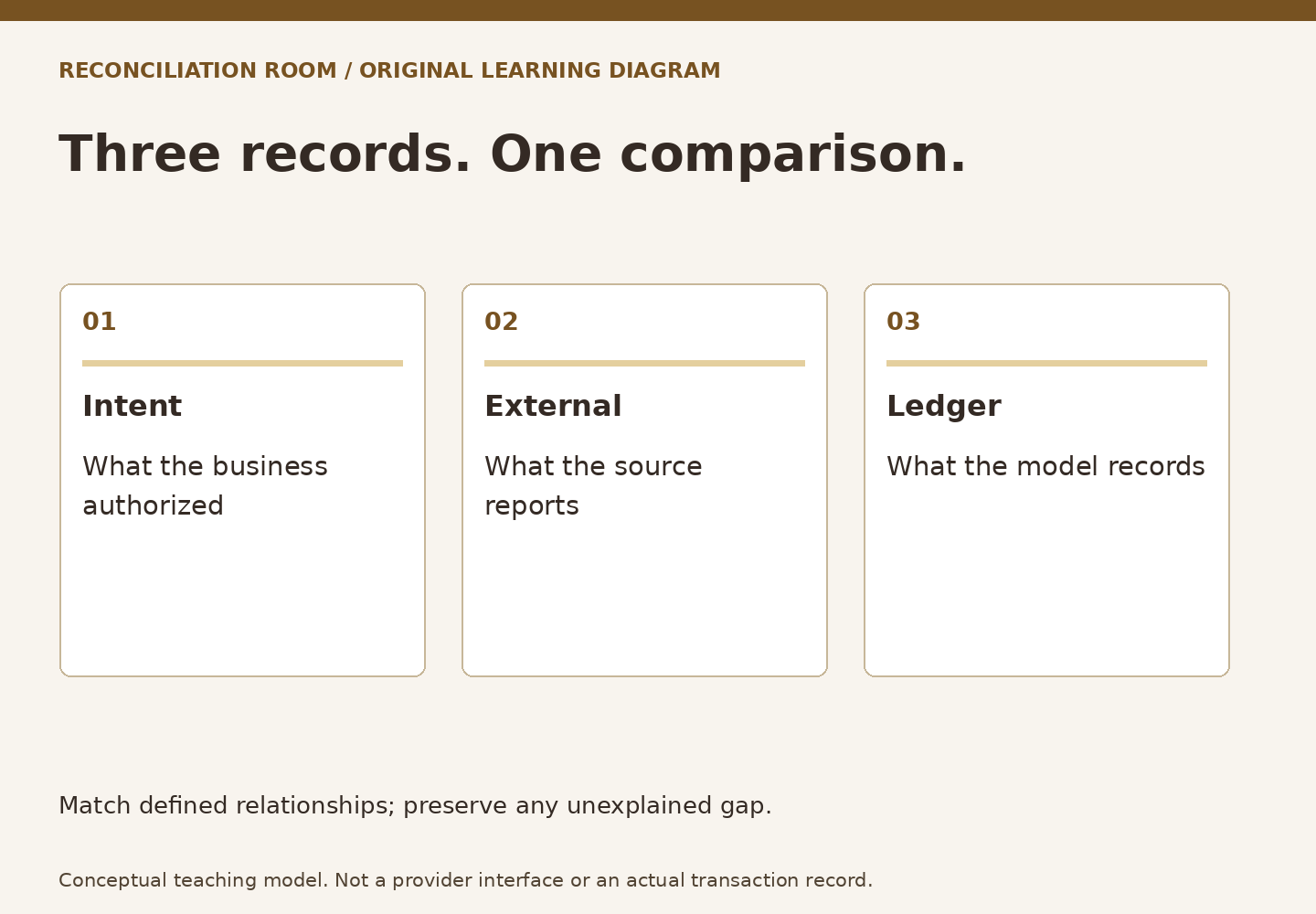
Choose the comparison
Reconciliation begins with a question: which records should agree, and on what basis? A business instruction describes intended activity. An external transaction record describes what a source reports. An internal ledger expresses the organization’s accounting model. Comparing them can reveal missing or inconsistent information, but it does not make one record a substitute for every other record.
Modern Treasury describes Ledgers as a financial record database that can operate independently of Payments. That separation matters when scoping a reconciliation process. An organization could use a ledger with payment evidence from elsewhere. Do not assume that selecting a ledger product automatically supplies every bank feed, payment integration or matching rule your process requires.
Build the reconciliation contract
Define the population first. State which entities, currencies, accounts, record states and time interval belong in the comparison. Then define the matching keys and permitted relationships. A one-to-one payment flow has different needs from a settlement that groups many business events. If the population changes halfway through the review, a movement in unmatched items may reflect scope rather than operational improvement.
A fictional marketplace expects several customer obligations to connect to one external settlement. Matching every obligation directly to the full settlement amount would misread the relationship. A more useful design identifies the group, explains its components and records any unresolved remainder. This example illustrates a data-model question; it does not recommend an accounting entry or certify a product feature.
Do not make totals do too much
Equal totals are a useful control but weak evidence of item-level correctness. One omitted debit and one omitted credit can leave an aggregate unchanged. Two incorrectly linked records may still sum to the expected amount. Add checks for population coverage, duplicated relationships and unexplained exclusions instead of stopping when a spreadsheet total looks tidy.
Keep control totals for the input population, accepted matches and remaining exceptions separately. Record the version of the source data and the observation time. An auditor or colleague should be able to reproduce the comparison from the same scope. Reproducibility is especially important when a later refresh adds records that were unavailable at the earlier review.
Make uncertainty visible
Use a small set of explanatory outcomes such as supported match, plausible candidate, missing evidence and confirmed inconsistency. These are editorial suggestions, not Modern Treasury status values. A candidate should not be counted as resolved just because the amount looks familiar. Require the evidence that your organization has approved for a supported match.
When a case remains open, record what is known, what is missing and who owns the next check. Keep the original records intact. A reconciliation note should explain the relationship, not rewrite inconvenient source evidence. If a correction is needed, use the authorized source-system workflow and preserve a trail connecting the old understanding to the new one.
A fictional tabletop exercise
Use a fictional set of five business events and two external groups. Give every event a short invented identifier, but leave one event without a group reference. Ask a colleague to explain the relationship using only the evidence supplied. Then add a control total that happens to agree. The missing relationship should remain unresolved even though the arithmetic looks complete. Finally, supply the missing grouping evidence and note exactly why the conclusion changed. This tabletop exercise tests whether the process rewards evidence or merely an attractive total. It also gives reviewers a shared example of the difference between a supported relationship and a plausible guess, without exposing customer data.
Your working questions
- Can another reviewer reconstruct the exact population, including exclusions and observation time? Save the scope in the approved work record, rather than relying on a verbal description.
- Is the relationship one-to-one, one-to-many or many-to-one? Document why the chosen match is justified and which identifiers establish the relationship beyond an equal amount.
- Do item-level coverage and duplicate checks agree with the totals? An equal aggregate is one control, not permission to close unresolved evidence gaps.
Use this as a discussion aid
The workflow in this article is an original educational framework. It is not a product configuration, accounting opinion, contractual promise or instruction to move funds. Keep real records in your organization’s approved systems, with the access and retention rules that apply there. A public documentation review cannot establish your permissions, bank coverage, implementation settings or operating agreements. Ask the authorized owner to verify those details before changing a process.
Source check: October 12, 2026. Product statements are limited to the linked official references below; fictional examples and proposed checklists are editorial teaching material. This independent publication is not Modern Treasury and cannot access an account or investigate a payment.
Continue the investigation
Turn an exception queue into an owned investigation · Separate event time, posting time and observation time · Build a close packet that another reviewer can reproduce