In this article
Keep scope, source versions, unresolved items and decisions together without collecting unnecessary private data.
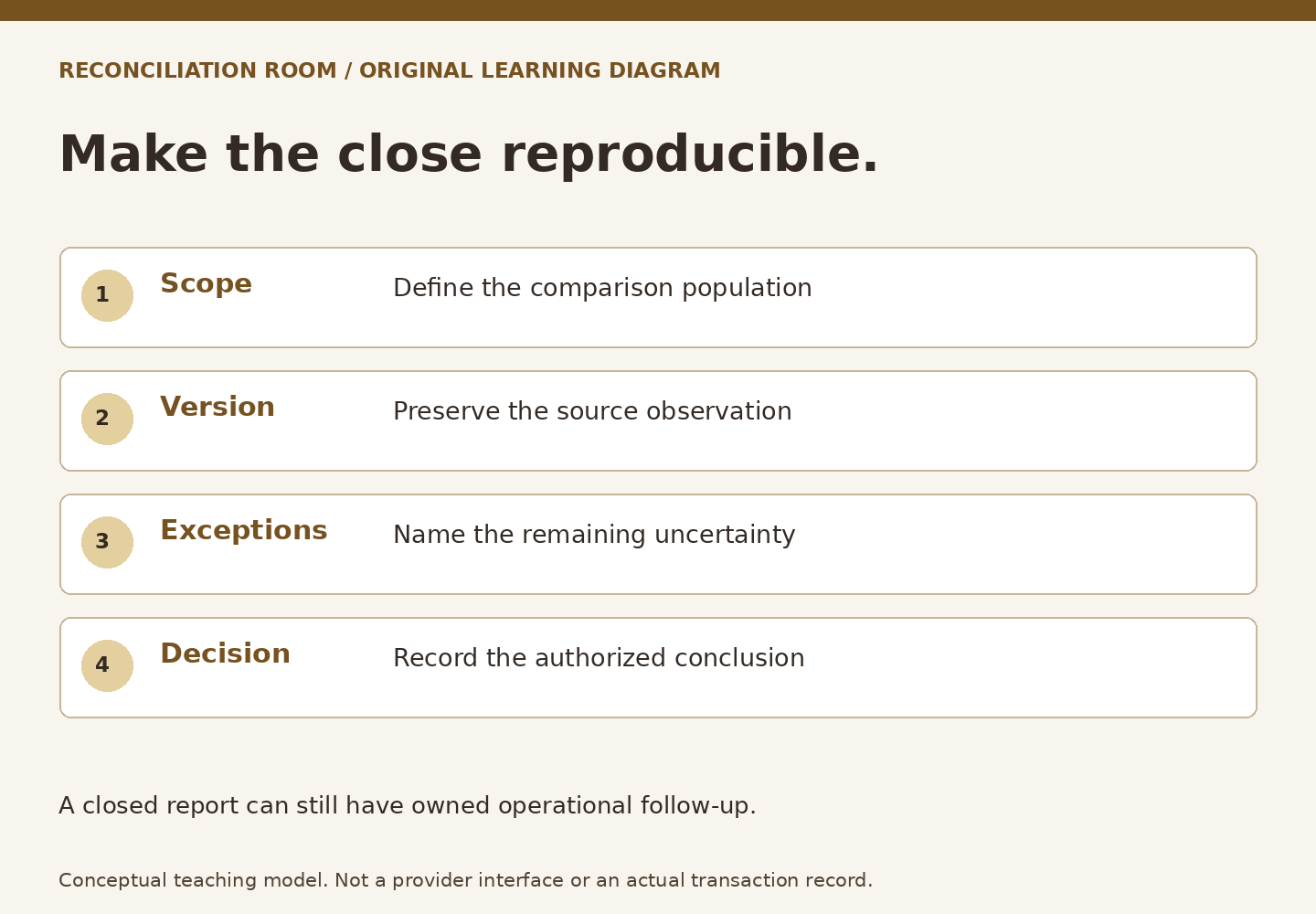
Design for the second reader
A close packet is useful when someone who was not present can understand the comparison and repeat its important checks. It should explain the population, the sources, the matching rules and the unresolved items. A screenshot of a green total may communicate confidence, but it rarely provides enough evidence to reproduce the result.
Start with a concise cover note: what period and entities are included, when the sources were observed, who prepared the work and who reviewed it. Use the actual organization’s approval and retention policies. This is an educational structure, not an audit opinion or a substitute for professional requirements governing financial reporting.
Preserve versions and scope
Data can change after a review. A source refresh may add late records, correct metadata or expose a previously missing relationship. Keep a version reference for the evidence used in the original review. If your approved systems retain historical snapshots, link to those; do not create uncontrolled copies merely because attachments are convenient.
Describe exclusions explicitly. An excluded account, currency or record state can explain why the packet differs from another report. An exclusion should have a reason and an authorized owner. Silence is not a scope definition. A reader should not need to reverse-engineer a spreadsheet formula to discover which population was left out.
Show unresolved work honestly
An open-item schedule should say what remains unknown, why it matters and who owns the next step. Distinguish an unresolved factual question from an approved accounting treatment. A decision about reporting does not necessarily end the operational investigation, and an operational match does not necessarily settle every accounting judgment.
For a fictional month-end packet, one external record arrives after the observation window. The packet can document the missing evidence and the follow-up condition without pretending the record was available at the earlier close. A later supplement should explain what changed and whether the original conclusion needs review, rather than silently rewriting the packet.
Minimize copies and make access intentional
Payment and ledger evidence can contain confidential business and personal information. Keep the packet in the approved environment and share only with authorized reviewers. Use references to protected records where possible. A public publication contact, a generic note-taking tool or an educational checklist is not an appropriate destination for account exports.
Before closure, check whether the evidence supports the stated conclusion and whether a reader can follow each important reference. Confirm the retention owner and the process for later corrections. A packet is a controlled explanation of work performed, not a permanent dumping ground for every file someone encountered during the investigation.
A fictional tabletop exercise
Give a colleague a fictional close packet with one deliberately omitted scope statement. Ask them to reproduce the total and explain what it covers. If they obtain the same number by guessing the missing scope, the packet still failed the exercise. Agreement reached through assumptions is not reproducibility. Add the missing definition and repeat with a changed source version. The reviewer should now be able to identify why the result changed. Use the exercise to improve the packet’s cover note and reference structure rather than to add more attachments. A smaller, clearly bounded evidence set can be easier to review than a large collection of unexplained files.
Ask the reviewer to mark any assumption they had to supply themselves, then resolve those gaps before describing the packet as complete.
Your working questions
- Can a second reviewer reconstruct the population and rule version from the packet alone? Identify source snapshots, observation times and exclusions with enough precision to repeat the important checks.
- Which open items remain after the reporting decision, and who owns them? Keep operational follow-up visible even when an authorized accounting conclusion has already been recorded.
- Are access and retention appropriate for every included record? Prefer protected references, avoid unnecessary copies and use the organization’s approved sharing and correction procedures.
Use this as a discussion aid
The workflow in this article is an original educational framework. It is not a product configuration, accounting opinion, contractual promise or instruction to move funds. Keep real records in your organization’s approved systems, with the access and retention rules that apply there. A public documentation review cannot establish your permissions, bank coverage, implementation settings or operating agreements. Ask the authorized owner to verify those details before changing a process.
Source check: October 12, 2026. Product statements are limited to the linked official references below; fictional examples and proposed checklists are editorial teaching material. This independent publication is not Modern Treasury and cannot access an account or investigate a payment.
Continue the investigation
Build a handoff that survives a shift change · Reconcile three records without flattening their meaning · Separate event time, posting time and observation time