In this article
Classify uncertainty, assign the next evidence request and avoid treating every unmatched item as a failed payment.
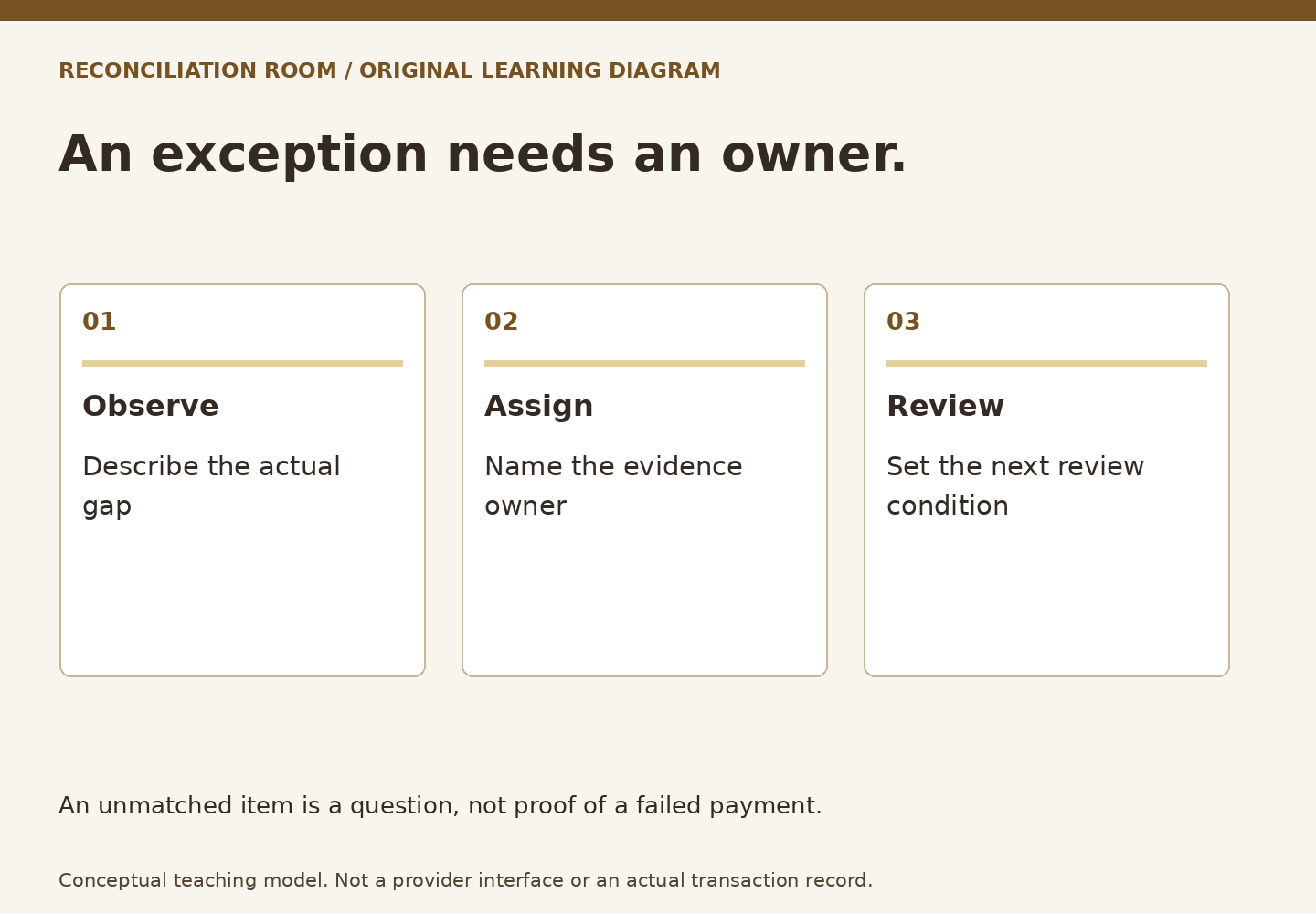
Separate a symptom from a conclusion
An unmatched item is a symptom in a comparison. It may result from delayed evidence, a reference mismatch, an intentional grouping, a duplicated record or an actual operational error. Labeling every unmatched item “failed” hides these differences and can cause unnecessary retries. Start with a neutral statement of what the comparison could not establish.
For example, “the instruction has no linked external record in this extract” is more precise than “the recipient was not paid.” The first sentence names an observation with a scope. The second claims an outcome that the evidence may not support. This distinction is central to a useful exception queue, regardless of which payment platform supplies the records.
Create a practical triage structure
Use fields for the observed gap, first observation time, business impact, evidence owner and next review condition. Keep the classification small enough that reviewers apply it consistently. A sprawling list of categories can become an excuse to move cases around without learning anything new. Include an unknown category so that uncertainty can be recorded honestly.
Suggested groups are missing source evidence, ambiguous linkage, inconsistent amount or currency, unexpected state and suspected unauthorized activity. These are educational queue categories rather than vendor status names. Security concerns need the organization’s incident route promptly; they should not wait behind ordinary matching work merely because both cases appear on the same operational dashboard.
Prioritize by consequence and dependency
Age alone cannot establish urgency. A recent case that blocks an important customer obligation may deserve attention before an older low-impact reporting discrepancy. Conversely, an old case can signal that the next owner or decision has never been identified. Use both impact and time, while preserving the actual contractual and regulatory requirements that your organization has verified.
A fictional queue contains one unclear reference and one suspected duplicate instruction. The first may need a data lookup. The second may require stopping an already authorized retry until the instruction state is understood. The queue should help authorized people recognize that difference; it should not automatically cancel, reverse or recreate a payment based on an educational rule.
Write a next action that can finish
“Investigate” is not a complete handoff. A stronger action identifies who will inspect which source and what answer they should return. For example: ask the owner of the source export whether the agreed reporting interval is complete. Specify the next review point using the actual operating agreement, not an invented universal deadline.
Closing an exception also needs a reason. The case might be matched with sufficient evidence, transferred to a separate incident or intentionally excluded under an approved scope rule. Preserve that explanation and the supporting reference. Do not count an item as resolved merely because someone removed it from the current view or changed its label.
A fictional tabletop exercise
Review three invented cases together: a source that has not refreshed, a reference with two plausible matches and an unexplained second instruction. Give the cases the same age so that age cannot decide the order automatically. Ask each reviewer to identify the possible consequence and the next source to inspect. Differences in their answers are useful design feedback. Resolve disagreements about the classification definitions before measuring individual performance with the queue. The exercise should end with an owner and a specific evidence request for each case. It should not end with an invented payment outcome, a universal deadline or an instruction to move funds.
Your working questions
- What does the evidence show, and what outcome is still unknown? State the observation without turning an absent link into a claim about settlement or recipient access.
- Who owns the next evidence request, and what answer would change the classification? Give the case a concrete review condition rather than an indefinite “pending” label.
- Would another payment attempt, correction or customer promise create additional risk? Keep consequential actions in the authorized workflow until the relevant state is verified.
Use this as a discussion aid
The workflow in this article is an original educational framework. It is not a product configuration, accounting opinion, contractual promise or instruction to move funds. Keep real records in your organization’s approved systems, with the access and retention rules that apply there. A public documentation review cannot establish your permissions, bank coverage, implementation settings or operating agreements. Ask the authorized owner to verify those details before changing a process.
Source check: October 12, 2026. Product statements are limited to the linked official references below; fictional examples and proposed checklists are editorial teaching material. This independent publication is not Modern Treasury and cannot access an account or investigate a payment.
Continue the investigation
A payment state and a ledger state answer different questions · A safe retry starts with a known operation identity · Build a handoff that survives a shift change