In this article
Read status labels in their own object model before using them to describe an outcome.
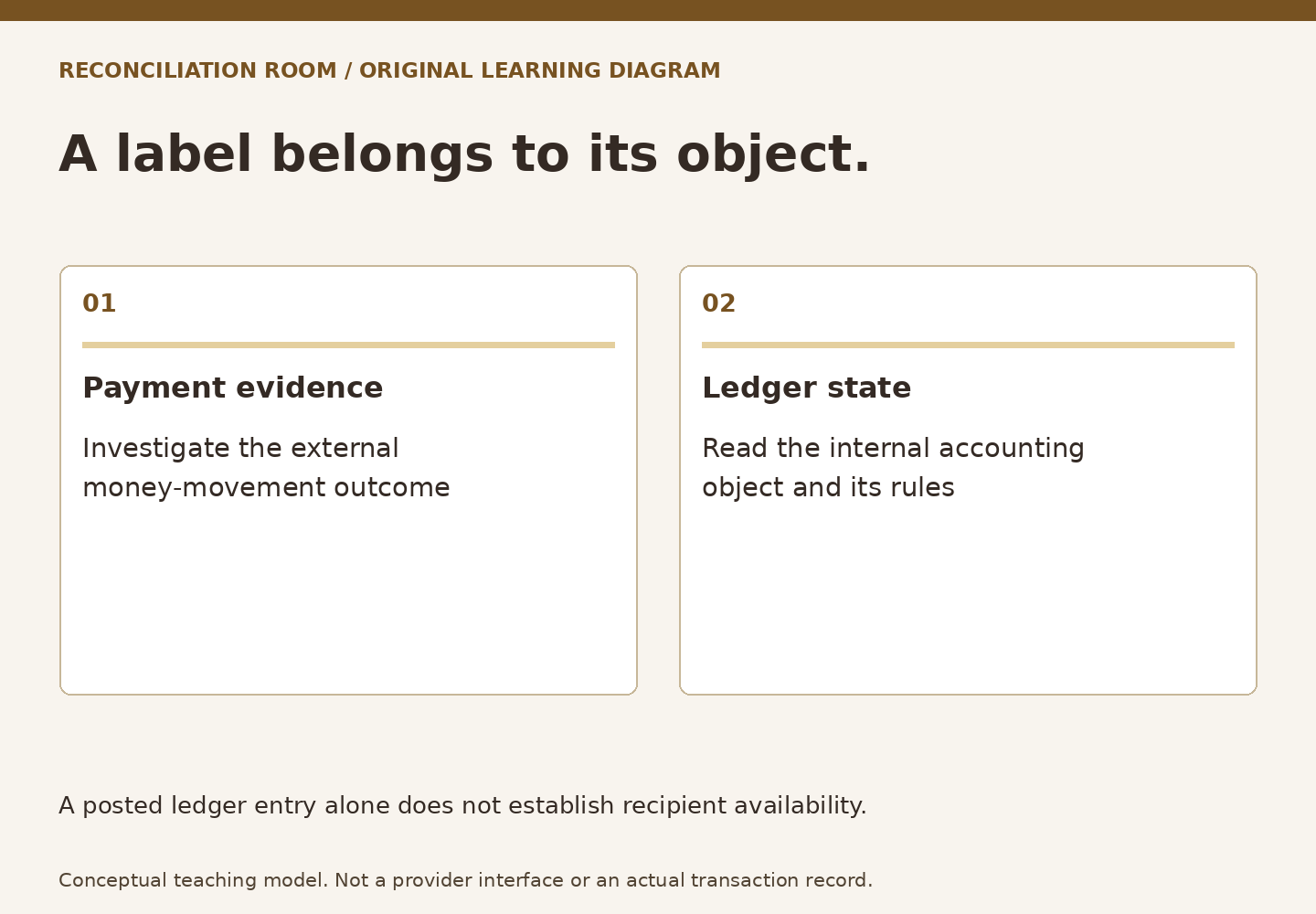
Attach the label to its object
“Posted” is incomplete without the name of the record it describes. A status on an internal accounting object, a status in a payment workflow and a label on an external bank record can each have a different meaning. Copying the word into a customer message without the object context can turn a narrow technical fact into an unsupported promise.
Modern Treasury’s Ledger Transaction documentation describes pending, posted and archived states. It also distinguishes balances associated with ledger accounts. Those definitions concern the ledger object model. Do not casually apply them to every payment rail, bank statement or recipient experience. Read the current documentation for the particular object and implementation before interpreting a state transition.
Keep the event and the record separate
A financial event may happen outside the ledger, while the ledger captures the organization’s model of that event. The recording time and the underlying event time can differ. An application can also write an incorrect entry promptly. Speed and precision of recording are valuable, but neither proves the input business event was described correctly.
A fictional operations team sees a posted ledger transaction and assumes its supplier can use the funds. The ledger state alone does not answer that receiving-side question. The team should inspect the relevant payment and external evidence, using the actual supported process. The point is not that the ledger is untrustworthy; it is that it answers a different question.
Understand correction constraints
The official status documentation explains that posted or archived ledger transactions have immutable status and entries; metadata remains editable. Undoing the effect of a posted transaction requires a second reversing ledger transaction. That design supports an auditable history rather than silent replacement. Applying a reversal still requires an authorized accounting decision and appropriate implementation controls.
Before a correction, ask whether the underlying event changed or the representation was wrong. A payment return, an incorrect account classification and a duplicated ledger write are different situations. They may all produce an unwanted balance, but the correct treatment cannot be selected by looking only at that balance. Preserve the causal explanation alongside the correction.
Build a status dictionary for humans
Write a short internal dictionary with the object name, source, exact label, known meaning and meanings it does not establish. Add who owns questions about the label. This can be more useful to customer-facing teams than a large technical schema because it exposes the assumptions most likely to leak into everyday language.
Review the dictionary when your integration changes. If an application renames several provider states into a simpler display, document that translation. A friendly label can be useful, but it should not erase distinctions that operations needs for handling returns, delays or unresolved evidence. Keep unknown outcomes visibly unknown until the appropriate source supports a conclusion.
A fictional tabletop exercise
Take a fictional message that says “the payment is posted” and rewrite it three ways, naming a different source each time. For the ledger version, state only what the internal record establishes. For the external-record version, describe the observed entry and its scope. For the recipient-facing version, identify what additional evidence would be needed before making an availability claim. If the third message cannot yet be supported, leave it unwritten and record the missing question. This exercise helps teams avoid turning a familiar status word into an assurance that no source actually made. Keep the examples separate from approved customer communication templates until the responsible owner reviews them.
Your working questions
- Which exact object carries this status, and where is its definition maintained? Quote the status accurately within approved internal records while keeping the surrounding interpretation separate.
- What additional evidence would support a claim about external movement or recipient availability? Do not let an accounting state silently become a service promise.
- If the representation needs correction, who approves the treatment and how will the original history remain traceable? Avoid changing labels merely to make an exception disappear.
Use this as a discussion aid
The workflow in this article is an original educational framework. It is not a product configuration, accounting opinion, contractual promise or instruction to move funds. Keep real records in your organization’s approved systems, with the access and retention rules that apply there. A public documentation review cannot establish your permissions, bank coverage, implementation settings or operating agreements. Ask the authorized owner to verify those details before changing a process.
Source check: October 12, 2026. Product statements are limited to the linked official references below; fictional examples and proposed checklists are editorial teaching material. This independent publication is not Modern Treasury and cannot access an account or investigate a payment.
Continue the investigation
Choose matching keys that explain why records belong together · A balanced ledger can still describe the wrong business event · Escalate an exception without exposing the whole account