In this article
Separate retrying a request from creating a new business instruction.
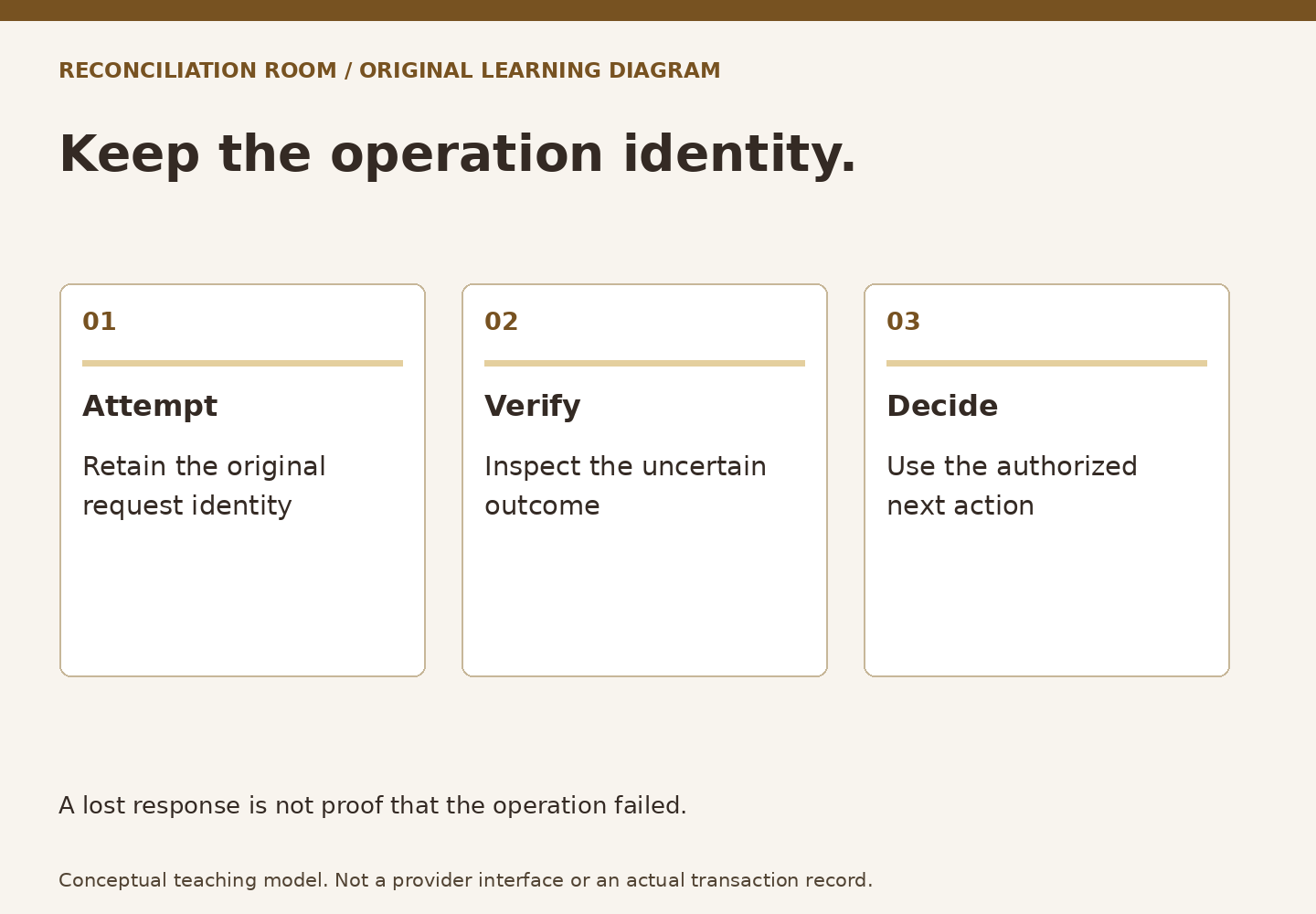
An uncertain response is not a negative result
A network interruption can leave a caller unsure whether an operation succeeded. Treating every uncertain response as a failure can create a second instruction when the first one already exists. The first task is to understand the operation identity and inspect the authorized source of truth. Do not infer absence merely because the caller did not receive the response it expected.
Modern Treasury’s Ledgers guarantees describe idempotency-key support for POST requests and uniqueness of a provided external transaction identifier within a ledger. Those are specific documented safeguards. Their scope is not a blanket promise that any payment retry, any endpoint or any integration can never duplicate a business event.
Give the business event a durable identity
Before implementing retries, decide what constitutes the same business operation. A supplier instruction, a correction and a replacement may be related but different. Reusing an identifier without understanding that distinction can suppress legitimate work; generating a new identifier on every attempt can defeat duplicate prevention. The policy belongs with the integration’s business semantics.
A fictional service receives a timeout after submitting a ledger write. It should retain the identity of that attempted operation, inspect the relevant response or lookup path and follow the current endpoint’s retry guidance. It should not invent a fresh business event merely because the original HTTP exchange was interrupted.
Separate transport recovery from business correction
Transport recovery asks whether the intended request was processed. Business correction asks whether the intended event itself was wrong. These require different evidence. A retry mechanism should not become an informal way to change an amount, destination or accounting treatment. Material changes need a new authorized decision and the correct traceable workflow.
Document how the application handles conflicting payloads, expired assumptions, concurrent callers and manual interventions. Use the provider’s current endpoint documentation rather than guessing the behavior from a generic idempotency description. A well-designed queue makes uncertain attempts visible and gives operators a safe investigation route before they create additional activity.
Test ambiguity on purpose
A happy-path test cannot show what happens when the response is lost after the server accepts work. Include interrupted responses, repeated deliveries and two workers handling the same business event. Use a sandbox with fictional data and verify the resulting object count and relationships. Record which version and configuration were tested.
Operational runbooks should explain when to stop retrying and escalate. An indefinite loop can amplify a bad request, overwhelm a dependency or conceal an unresolved state. Backoff and retry limits are implementation decisions to make from the actual API contract and risk assessment. This article supplies questions for that discussion, not executable production retry instructions.
A fictional tabletop exercise
Use a tabletop sequence in which the server accepts a fictional operation but the caller never receives the response. Ask one person to act as the application and another as the operator. Give both the same business reference and see whether their proposed recovery paths could create separate work. Then repeat with an intentionally changed business instruction. The two situations should not be handled identically. Document the evidence needed to distinguish them and the role allowed to authorize the changed instruction. This rehearsal does not validate a production API; it exposes decision gaps that should be addressed in implementation tests and the approved incident runbook.
Keep the resulting recovery policy accessible to on-call staff, and include a clear route for unresolved operation identity rather than improvising a new request.
Your working questions
- What makes two attempts the same business operation? Keep that identity stable through transport recovery and document when a correction requires a distinct authorized operation.
- Which endpoint-specific guarantees and constraints apply? Confirm them in current official documentation, including how the integration handles mismatched payloads and concurrent attempts.
- Can the team observe an uncertain result without immediately creating another instruction? Test interruption cases and give operators a clear escalation path with preserved evidence.
Use this as a discussion aid
The workflow in this article is an original educational framework. It is not a product configuration, accounting opinion, contractual promise or instruction to move funds. Keep real records in your organization’s approved systems, with the access and retention rules that apply there. A public documentation review cannot establish your permissions, bank coverage, implementation settings or operating agreements. Ask the authorized owner to verify those details before changing a process.
Source check: October 12, 2026. Product statements are limited to the linked official references below; fictional examples and proposed checklists are editorial teaching material. This independent publication is not Modern Treasury and cannot access an account or investigate a payment.
Continue the investigation
A balanced ledger can still describe the wrong business event · Build a handoff that survives a shift change · Turn an exception queue into an owned investigation